
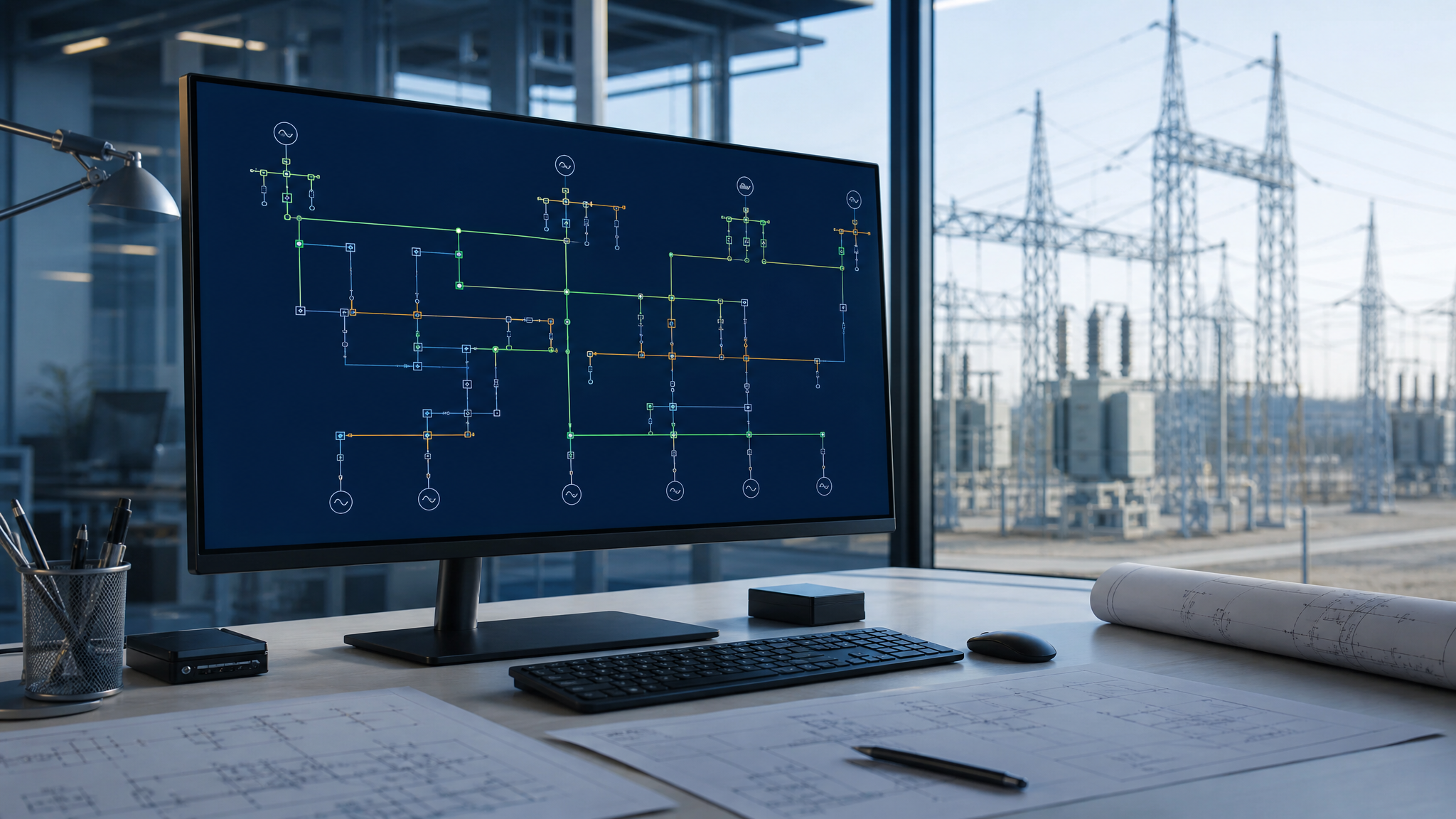
A power system modelling consultant builds and analyses a validated digital model of your electrical network to answer questions about load flow, fault levels, protection coordination and arc flash. Choosing the right one comes down to a few concrete things: proven expertise in SKM PowerTools or ETAP, chartered and registered engineers (CPEng, RPEQ), real experience in your sector, and the ability to turn work around without months of delay. Get those right and the model becomes a trusted asset; get them wrong and every downstream study inherits the error.
This is a buyer’s guide to choosing a modelling consultant — what to look for, the questions to ask, and the red flags that should give you pause.
What should you look for in a modelling consultant?
Software expertise (SKM PowerTools or ETAP)
The two industry-standard packages for power system analysis are SKM PowerTools for Windows (PTW) and ETAP. A capable consultant works in one or both daily, not occasionally. Ask which they use and how routinely — a firm that lives in the software builds models faster and catches the subtle errors a casual user misses.
Chartered and registered engineers (CPEng, RPEQ)
The analysis is only as trustworthy as the engineer signing it. Look for CPEng (Chartered Professional Engineer) and, for work in Queensland, RPEQ (Registered Professional Engineer of Queensland) registration. In many jurisdictions and for many clients this isn’t optional — it’s a compliance requirement. Confirm the individuals doing the work hold the credentials, not just the firm.
Relevant sector experience
Modelling a hard-rock mine, a hyperscale data centre and a utility-scale solar farm each carry different challenges — long reticulation and motor starting on a mine, redundant parallel paths on a data centre, fault contribution and grid-connection requirements on renewables. A consultant with genuine experience across mining, data centres and renewables brings pattern recognition you can’t get from a single-sector background.
Arc flash capability
Arc flash assessment per IEEE 1584 should be part of the core offering, not outsourced or bolted on. Because coordination determines clearing times and clearing times drive incident energy, the same consultant should be able to take you from model to fault study to coordination to arc flash labelling in one coherent piece of work.
Turnaround and responsiveness
A model that arrives six months late is a problem, especially on a construction programme that won’t wait. Ask about typical turnaround and current capacity. Responsiveness during the project — quick answers to clarifications — matters as much as the final report.
Local NSW/QLD presence
A consultant with a genuine presence in NSW and QLD understands the local network operators, connection requirements and site conditions, and can get to site when validation against real measurements is needed. Local knowledge shortens the path from model to a result you can trust.
What questions should you ask a modelling consultant?
- Which software do you model in, and how often?
- Who will actually do the work, and what are their CPEng/RPEQ credentials?
- Can you show comparable projects in my sector?
- Do you perform arc flash to IEEE 1584 in-house?
- How do you validate the model against real network data?
- What’s your typical turnaround, and what’s your current capacity?
- How are the settings, reports and study data stored and handed over?
What are the red flags?
- No named registered engineer. If the firm can’t tell you who holds the CPEng/RPEQ and will sign the work, walk away.
- Vague about software. A consultant who’s cagey about which package they use, or uses it rarely, is a risk.
- Guessed data, no validation. A model built on assumed impedances with no plan to validate it produces confident but wrong answers — and every study inherits the error.
- Arc flash treated as an afterthought. Safety-critical output shouldn’t be an optional extra.
- No auditable handover. If settings and reports aren’t stored in a form your team can retrieve and audit later, the next study starts from scratch.
How JMB approaches it
At JMB Engineering, models are built and maintained in SKM PowerTools (PTW) by chartered and registered engineers, with arc flash to IEEE 1584 performed in-house. We work across mining, data centres and renewables from a NSW base, and all protection settings and study outputs are stored on our Protection Database platform for auditable, easy handover. The point isn’t to sell you a report — it’s to leave you with a model accurate enough to trust and cheap to update next time.
The bottom line
Choosing a power system modelling consultant is about verifying four things: the software expertise, the registered engineer behind the work, relevant sector experience, and a disciplined approach to data and validation. A model built well by the right people underpins your protection, your safety case and your equipment decisions for years. A model built carelessly quietly poisons every study that follows.
Looking for a power system modelling consultant? Explore our power system studies and protection engineering capabilities.
FAQ
What does a power system modelling consultant do?
They build a validated digital model of an electrical network and use it to run load flow, fault level, protection coordination and arc flash studies. The model answers “what if” questions — adding load, switching to generators, connecting new plant — before those changes are made on the real network.
What qualifications should a power system modelling consultant have?
Look for chartered engineers (CPEng) and, for Queensland work, RPEQ registration, backed by daily expertise in SKM PowerTools or ETAP. Confirm the individuals performing and signing the work hold the credentials, not just the firm as a whole.
Should the same consultant do arc flash as well as coordination?
Ideally yes. Arc flash per IEEE 1584 depends on the clearing times set by protection coordination, so a consultant who does both in-house delivers one coherent piece of work — from model to fault study to coordination to arc flash labelling — rather than a disjointed hand-off.
How do I know a power system model is accurate?
Ask how the model is validated. A good consultant builds from verified network data and checks the model against real site measurements where possible, rather than relying on assumed impedances. An unvalidated model can give confident answers that are quietly wrong.
—
JMB Engineering Pty Ltd — electrical engineering consultancy specialising in power system studies, protection, earthing and modelling for mining, data centres, renewables and heavy industry. Thornton, NSW.
