
Power System Modelling with SKM PowerTools: What It Is and Why It Pays Off
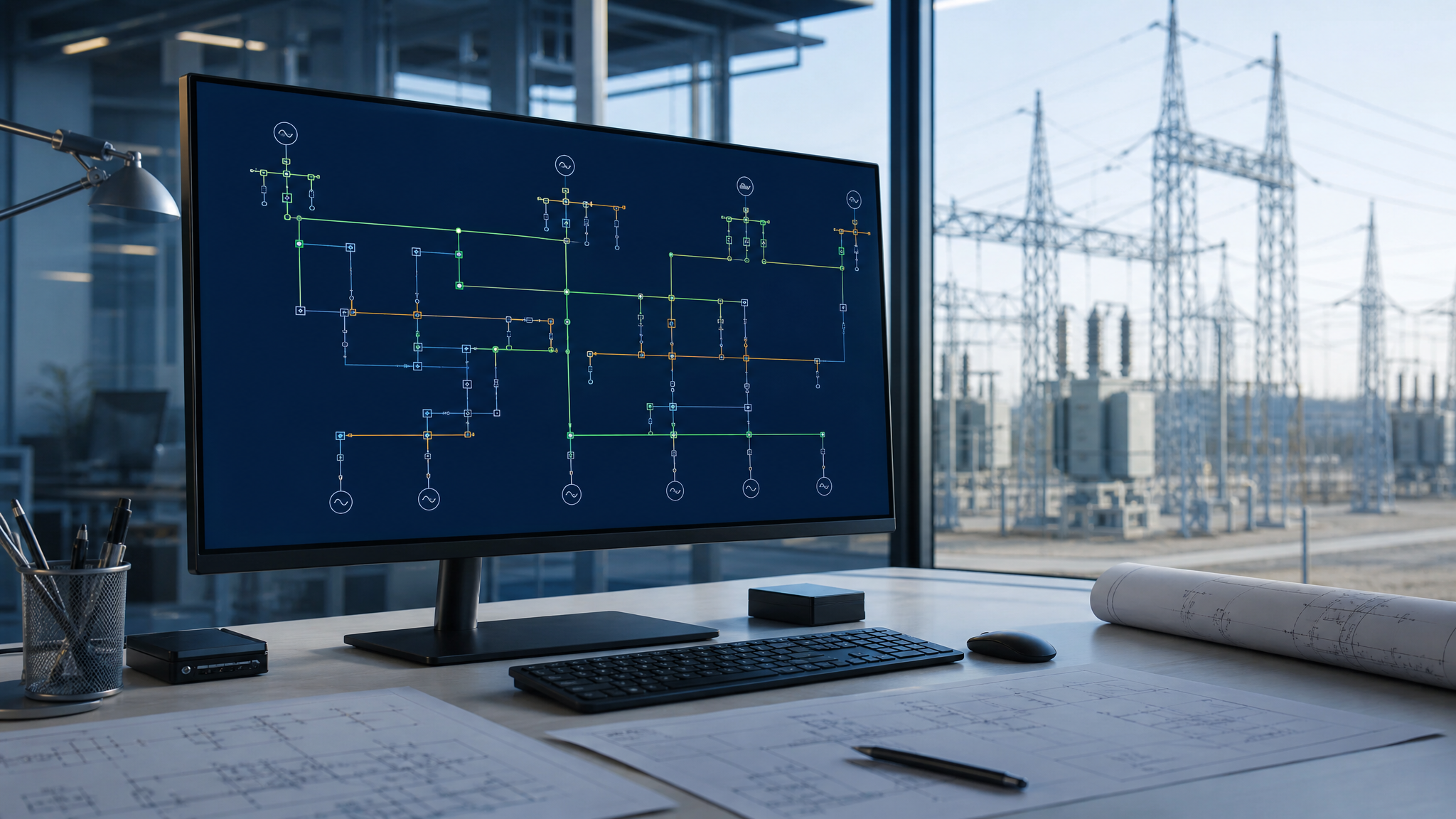
If a fault level study tells you how much current can flow, a power system model is the thing that calculates it — along with almost every other electrical question worth asking about your network. Think of it as a digital twin of your electrical system: an accurate, maintained representation of every source, transformer, cable and load, built so you can test what the real network would do before it does it.
At JMB Engineering, that model is built and maintained in SKM PowerTools for Windows (PTW) — the industry-standard package for power system analysis across the Australian mining, data centre, renewables and heavy industry sectors.
What a power system model actually contains
A useful model isn’t a sketch — it’s a validated dataset. It captures:
- The source — utility connection strength, or the characteristics of on-site and standby generation.
- Transformers — ratings, impedances, tap ranges and connections.
- Cables and lines — lengths, sizes, impedances and routing.
- Loads and motors — including their contribution to fault current and their starting behaviour.
- Protection devices — relays, fuses and their settings.
Built once and kept current, that single model becomes the engine behind every study you need.
What you can do with it
The reason modelling pays off is that one well-built model answers many questions:
Load flow analysis — confirms voltages stay within limits and equipment isn’t overloaded under real, diversified operating conditions. Essential before adding load or reconfiguring the network.
Fault level (short-circuit) studies — quantifies fault current everywhere, so equipment ratings and protection can be verified. (More on this in our fault level study explainer.)
Protection coordination — grades relays and devices so the closest one to a fault clears it, and only it. Impossible to do properly without the model behind it.
Arc flash assessment — combines fault levels and clearing times to determine incident energy and PPE categories.
Motor starting studies — checks that large motor starts won’t cause damaging voltage dips or stall other plant.
Scenario testing — the real payoff: what if we add this transformer? Switch to generators? Connect this new load? You answer it in the model, not by finding out the hard way on site.
Why an accurate, maintained model matters
The value of a model is entirely in its accuracy. A model built on guessed impedances or out-of-date network data gives confident-looking answers that are quietly wrong — and every downstream study inherits the error.
That’s why we treat modelling as an ongoing discipline, not a one-off. We build models from verified data, validate them against site measurements where possible, and update them as the network changes. When a model is maintained, the next study is fast and cheap; when it’s neglected, every study starts from scratch.
As a value-add, all protection modelling data — relay settings, coordination reports and study outputs — is stored on our Protection Database platform, giving your team an auditable, easy-to-access record.
Beyond mining: data centres and renewables
Power system modelling isn’t just a mining discipline. Data centres, with their multi-stream redundancy and critical uptime requirements, are among the most modelling-intensive facilities being built today — as our work on the DigiCo SYD1 data centre shows. Renewable projects — solar, wind and battery storage — need modelling for grid connection, fault contribution and protection. The same PTW rigour applies across all of them.
The bottom line
A power system model is the single most leveraged asset in electrical engineering: build it once, well, and it underpins your protection, your safety case, your equipment decisions and your ability to plan changes with confidence. The question isn’t really whether to model your network — it’s whether your current model is accurate enough to trust.
Need a model built, updated or validated? Contact JMB Engineering — or explore our full power system studies capability.
