
What Is a Fault Level Study — And Why Your Site Needs One
Almost every important decision in an electrical network — what switchgear to buy, how to set the protection, whether it’s safe to work on — traces back to a single question: how much current will flow if something faults?
That number is the fault level (or prospective short-circuit current), and quantifying it across your network is the job of a fault level study. It’s one of the most fundamental power system studies there is, and getting it wrong has consequences that range from nuisance to catastrophic.
What a fault level actually is
When a short circuit occurs — a cable fails, an animal bridges a busbar, insulation breaks down — the network dumps current into the fault. How much depends on the “strength” of the supply behind that point: the utility connection, transformers, generators, cables and motors all contribute.
Close to a strong utility supply, fault currents can reach tens of kiloamps. Deep in a network, behind impedance, they’re far lower. A fault level study calculates this value at every point in the system, for the fault types that matter:
- Three-phase faults — usually the highest current; drives equipment ratings.
- Single-phase-to-earth faults — critical for earthing design and earth-fault protection.
- Phase-to-phase and two-phase-to-earth — needed for complete protection grading.
The study also distinguishes the initial (sub-transient) peak — the instantaneous mechanical stress equipment must survive — from the steady-state value that protection ultimately clears.
Why it matters: three things that depend on it
1. Equipment must be rated to survive the fault
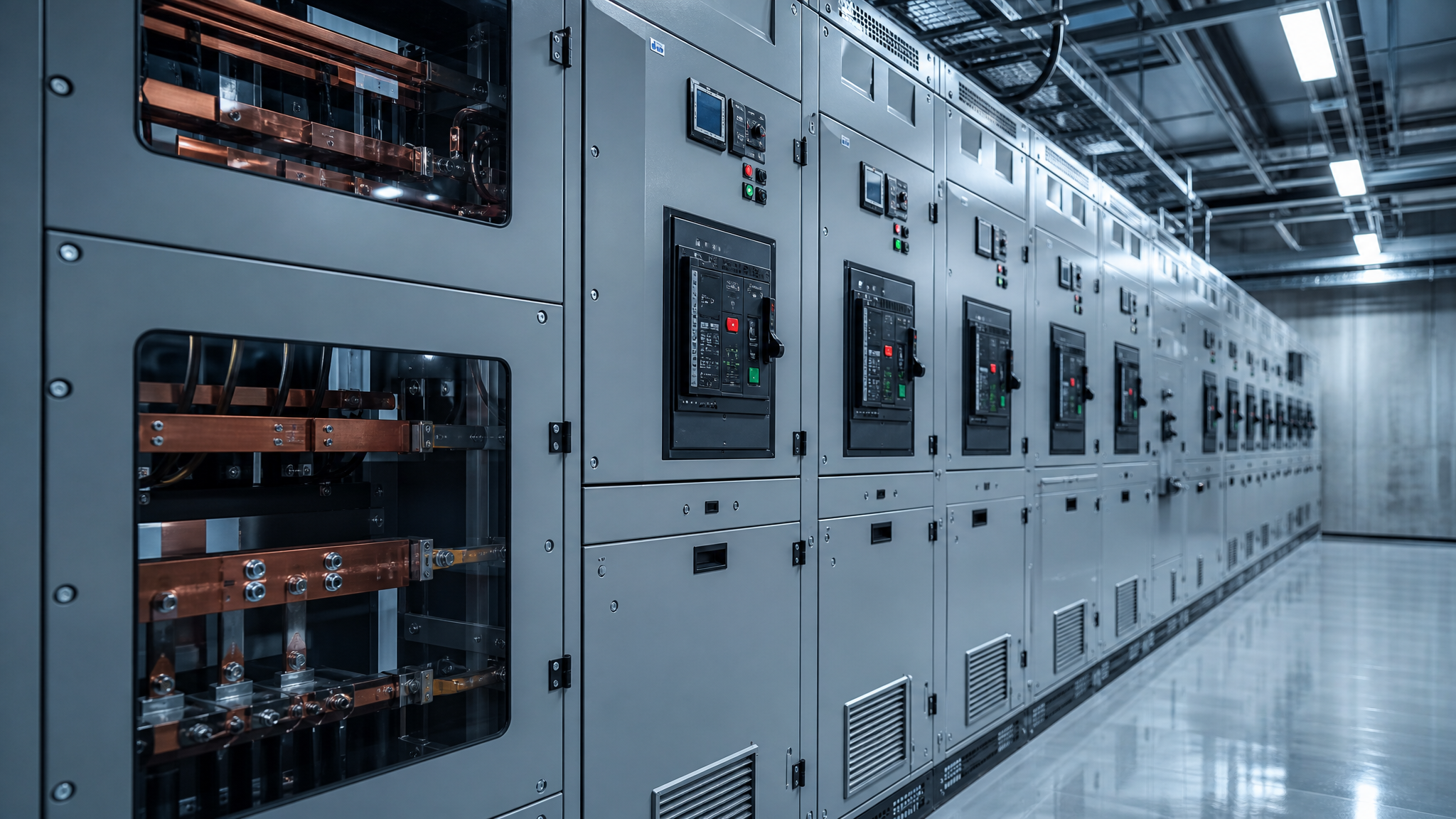
Every switchboard, circuit breaker and busbar has a short-circuit withstand rating — the maximum fault current it can safely interrupt or endure without exploding. If the available fault level exceeds that rating, the equipment can fail violently during a fault. A fault level study confirms your switchgear is rated for the network it sits in. On growing sites, it’s common to discover that network upgrades have pushed fault levels above the rating of older switchboards — a serious, and often invisible, hazard.
2. Protection can’t be set without it
Protection relays are graded using fault current. Overcurrent and earth-fault settings, discrimination between upstream and downstream devices, and clearing times are all calculated from the fault levels at each location. Set protection against the wrong fault data and it either trips too readily or — worse — fails to detect a genuine fault. Reliable protection engineering is impossible without an accurate fault level study underneath it.
3. It underpins arc flash and worker safety
The energy released in an arc flash is a direct function of the available fault current and the time protection takes to clear it. Arc flash assessments (IEEE 1584) — which determine the PPE category workers need to safely approach equipment — are built directly on fault level data. No fault study, no defensible arc flash result.
When you need one
A fault level study isn’t a one-off. It should be revisited whenever the network changes materially:
- Connecting a new supply — a new transformer, a larger utility connection, or an embedded generator all shift fault levels.
- Adding large loads or motors — motors contribute to fault current.
- Switching to temporary or backup generation — fault levels can *collapse*, which is its own hazard (see our insight on temporary generator power for mine outages).
- Buying or extending switchgear — to confirm ratings before commitment.
- After years without review — cumulative changes quietly move the numbers.
How JMB Engineering does it
We build the study on a detailed power system model in SKM PowerTools (PTW) — the industry-standard package. The model captures your utility source, transformers, cables, generators and motors, and calculates fault levels at every bus for all relevant fault types.
The deliverable is a clear report: fault levels tabulated across the network, equipment ratings checked against them, and any exceedances flagged with recommendations. Those results then flow straight into protection grading and arc flash assessment — one consistent model behind all of it.
We apply this to underground and open-cut mines, data centres, renewables and heavy industry alike. On the DigiCo SYD1 data centre, for example, the same fault-level rigour used on complex mine reticulation underpinned the protection studies for a highly critical facility.
The bottom line
A fault level study is the number the rest of your electrical safety case is built on. It confirms your equipment can survive a fault, lets your protection be set correctly, and makes arc flash results defensible. If your network has changed — or you’re not sure when it was last checked — it’s worth confirming.
Planning network changes or unsure of your current fault levels? Contact JMB Engineering to discuss a fault level study.
