Intro
Intelligent Truck Alignment for Safer, More Efficient Loading Operations
Accurate truck positioning is a critical part of safe and efficient loading operations. If a truck approaches a loading lane off-centre, at the wrong angle, or outside the desired path, it can lead to slow positioning, operator uncertainty, spillage, loading delays and increased risk around fixed infrastructure.
JMB Automation has developed an intelligent Truck Alignment Software platform that uses AI vision to detect approaching trucks, assess their alignment in real time, and guide operators into the correct loading position.
Using a live camera feed, a configurable detection area and a target approach line, the system provides a practical way to guide truck movements into a loading lane. The alignment result is linked back into the control system and then onto indication lights, giving the operator simple feedback during approach.
The result is a site-ready guidance system that improves consistency, reduces guesswork and supports safer loading operations.
The Challenge: Truck Positioning Is Often Inconsistent
In many loading applications, truck positioning depends heavily on operator judgement.
Drivers are often expected to line up with a loading point, chute, sock or lane using visual reference, painted lines or site experience. In real operating environments, this can be made harder by restricted visibility, night operation, weather, glare, dust, varying truck sizes, tight loading lanes and limited room to correct the approach angle.
When a truck enters the lane poorly aligned, the result can include slower positioning, multiple correction attempts, increased loading time, uneven placement under the loading point, spillage risk and greater reliance on manual guidance.
Traditional methods such as painted guide lines, traffic lights or operator experience can help, but they do not actively measure where the truck is relative to where it should be. What is needed is a system that can see the truck, compare it to the ideal approach path and provide real-time feedback.
The Solution: AI-Based Truck Alignment Guidance
JMB Automation’s Truck Alignment Software uses machine vision and AI detection to monitor the loading lane and identify when a truck enters the approach area.
Once detected, the system compares the truck position against a custom target approach line configured for the site. This line represents the ideal path the truck should follow as it moves toward the loading point.
The software operates within a defined detection area, ensuring that truck tracking and guidance only occur within the valid approach zone. This allows the system to determine whether the truck is correctly aligned, left or right of the ideal path, entering at the wrong angle, outside the detection area, or correctly positioned for continued approach.
That information is then passed back to the control system, which can drive indication lights and provide clear feedback to the truck operator.
How the System Works
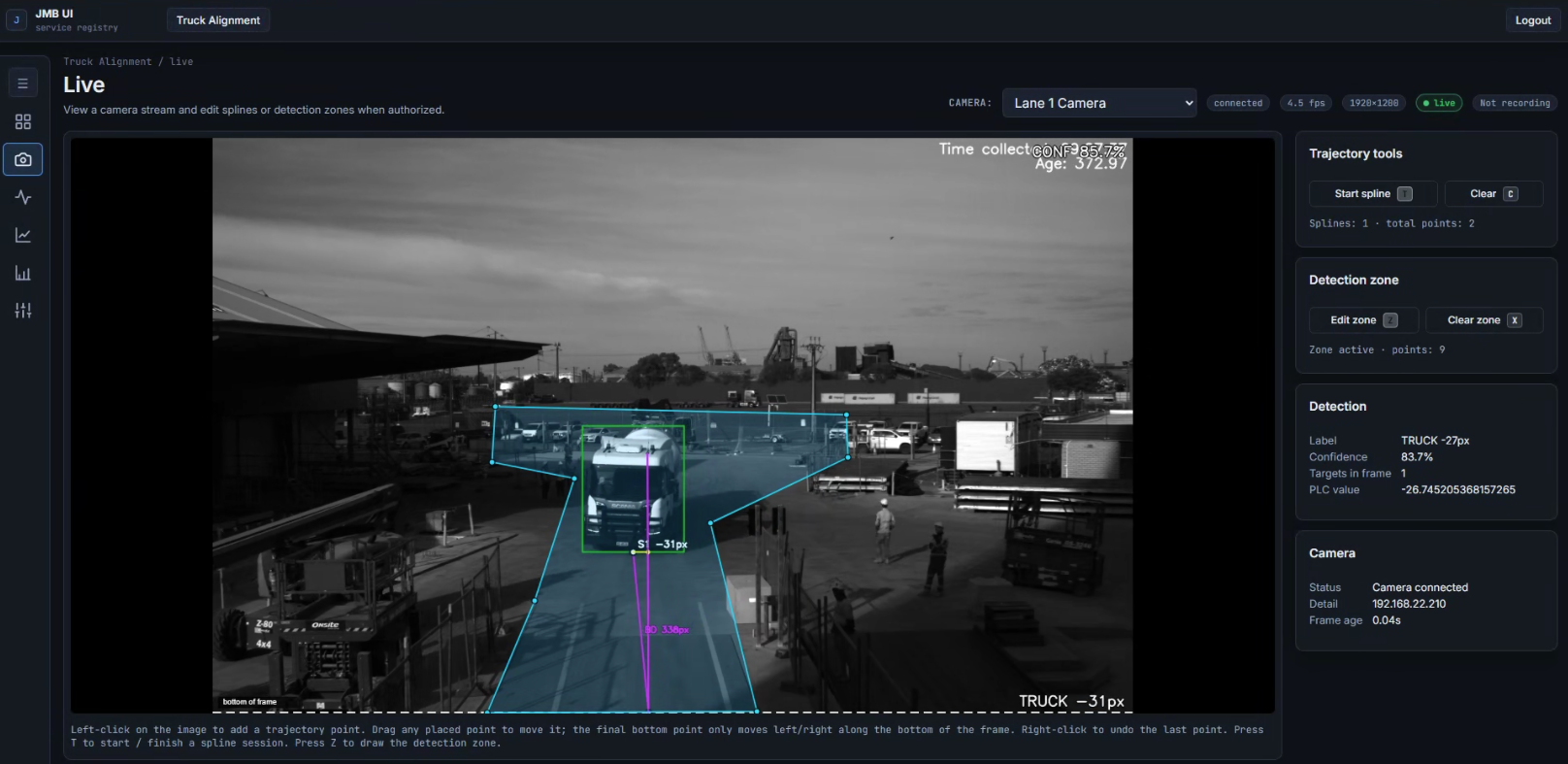
The system uses a live industrial camera to monitor the truck loading lane in real time. The operator or site team can view the lane through the dashboard, which displays the active camera stream and the configured guidance overlays.
A configurable detection area defines the section of the lane where vehicle monitoring and alignment logic are active. This helps the software focus on relevant vehicle movement and ignore background activity outside the approach zone.
At the centre of the system is the target approach line. This is a configurable reference line that represents the preferred truck path into the lane. Because the line can be adjusted, the system can be tailored to suit different site layouts, camera mounting positions, loading lane geometries and truck sizes.
The AI detection model identifies trucks as they enter the detection area. The software then continuously assesses the truck’s position relative to the target approach line and produces an alignment result in real time.
This result is sent to the control system, where it can be used to control indication lights, HMI or SCADA status, warning logic, loading permissives or future reporting.
Dashboard Visibility and Operator Support
A key part of the system is the live dashboard interface.
The dashboard provides visibility of the live camera feed, detection area, target approach line, detection status, camera health, system state, vehicle detection confidence and PLC-linked status values.
This gives site personnel a practical tool for setup, monitoring and troubleshooting. Rather than operating as a black box, the dashboard shows how the truck is being assessed and how the guidance logic is responding.
Key Benefits
The Truck Alignment Software can support loading operations by helping operators approach the loading lane more consistently and confidently.
Key benefits include:
- Reduced operator guesswork
- More consistent truck approach paths
- Faster positioning into the loading lane
- Reduced reliance on manual guidance
- Better alignment under loading points
- Lower risk of mispositioning
- Reduced spillage risk
- Improved traffic flow through the loading area
- Integration with existing PLC, HMI and indication systems
The system is especially useful where repeatable truck positioning matters and where simple operator feedback can make a meaningful difference to loading consistency.
Turning Vision Into Practical Guidance
The value of the system is not just that it detects a truck. The value is that it interprets the truck’s position in context, compares it against the ideal approach path and converts that information into simple guidance for the operator.
By linking AI vision with the control system, JMB Automation’s Truck Alignment Software turns live camera data into practical operational feedback.
This makes it a useful solution for loading lanes, truck loading points and industrial sites where safer, more consistent truck positioning is required.
Delivering Intelligent Automation
JMB Automation develops practical automation platforms that combine machine vision, AI and industrial control system integration.
The Truck Alignment Software is another example of how intelligent automation can solve real operational problems by turning live visual data into clear, actionable guidance for operators in the field.

